

Global Employment Guides
Top ADP Alternatives for EOR Services in 2026
Discover top ADP alternatives for SMEs in 2026. Learn how Rivermate, Payoneer and Remote provide stronger payroll, compliance and global hiring services today.

Lucas Botzen
Industry Insights and Trends
8 mins read
Author
Published on:
May 2, 2025
Updated on:
Mar 29, 2026



Our Employer of Record (EOR) solution makes it easy to hire, pay, and manage global employees.
Book a demoPapaya Global has successfully established itself as a key global payroll and workforce management service provider for over a decade. Their single integrated platform is built for strong compliance management and supports international staff across jurisdictions worldwide.
Despite this, Papaya Global may no longer be the best (or only fit) for your global operations. Future-of-work platforms are rapidly adapting their service plans to address global employment challenges, opening the field for companies to find their perfect international hiring match.
We examine the best Papaya Global alternatives in 2026: Rivermate, Remote, and Rippling. We look into what they do differently and the pros and cons of each product.
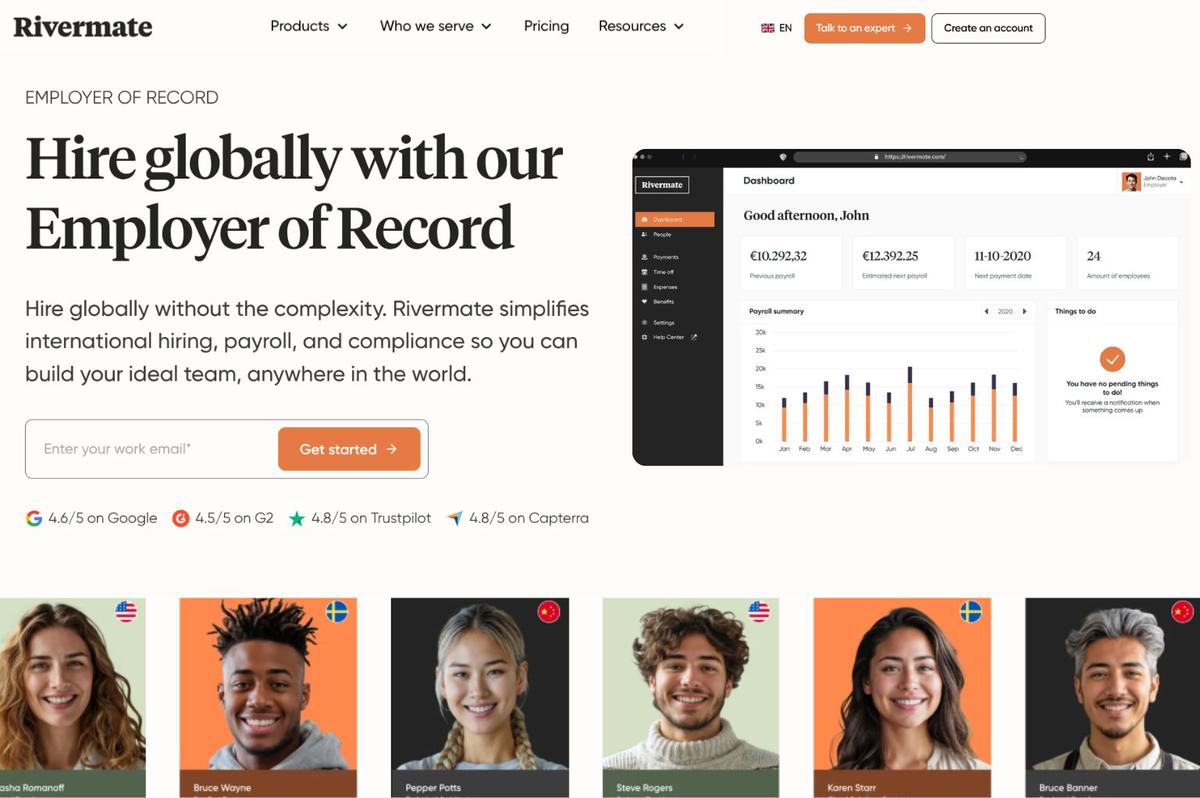
Primary reason for moving from Papaya Global to Rivermate: Papaya is a workflow-heavy global workforce management system. This works until you need customization and high-level expertise in tough employment environments. That’s when Rivermate’s 24/7 human-first support becomes invaluable.
Pros
Rivermate’s strongest proposition is that it offers startups and SMEs something that is becoming rare in the EOR space. They’ve designed their platform to function as a powerful, yet user-friendly driver of global payroll and hiring. But they’re focused on providing these services through extensive interaction with local country experts. Rivermate promises real access to experts via Slack, WhatsApp, and email. No bots, just real people.
In addition to offering global employee and contractor management, Rivermate aims to be a true HR partner to businesses. They don’t just provide you with a platform for compliant global employment. They are interested in understanding your business so they can help you secure the world’s top international employees.
Rivermate is highly praised for its ability to simplify hiring, benefits administration, and local labor laws. According to one user, Rivermate enabled them to hire leading medical and scientific researchers in three different countries without establishing local entities. The process was seamless, and the platform provided the oversight needed for complex international hires.
Lastly, Rivermate offers a flat-free structure per employee. This eliminates hidden costs that can quickly accumulate, and helps startups and SMEs manage tight budgets.
Cons
An employee and contractor management platform, like Rivermate, is continually challenged to balance user expectations, functionality, and its core focus: Human-first support in global hiring. While Rivermate users call for greater reporting depth and small changes to how they can access information, they acknowledge that this isn’t a hindrance to meeting their hiring objections. Overall, the platform is highly rated by users on G2.
If you’re ready to establish a global hiring partnership with Rivermate and discover the ways they can help you meet your global expansion objectives, register on the Rivermate platform now.
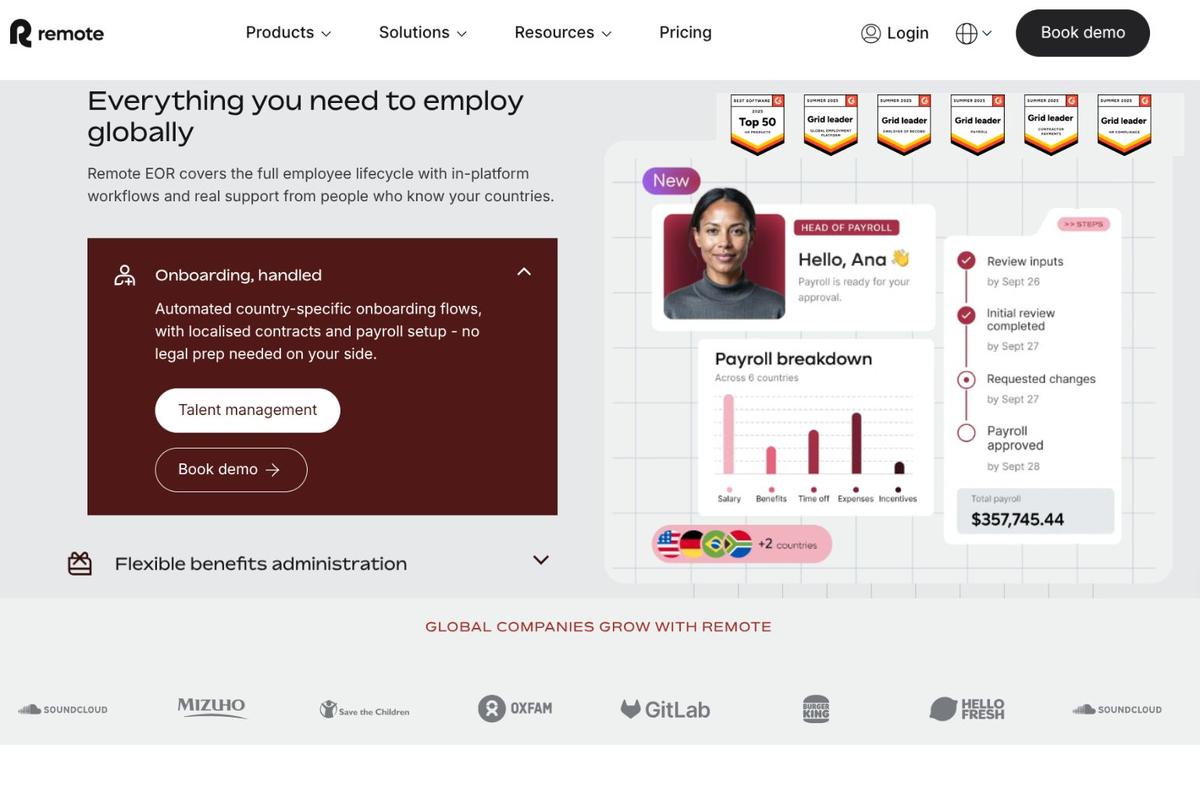
Primary reason for moving from Papaya Global to Remote: The biggest motivators are compliance and an easy-to-use platform. Remote has built a unified benefits administration, Employer of Record (EOR), IT management, and multi-currency payroll system. They are solely accountable for the compliance of all your HR processes, whereas Papaya Global splits accountability with its third-party partner network.
Pros
Managing global teams is complex. There are finance systems, local regulations, benefits management, tax regulations, international contractors, payments and extensive document management involved. Remote neatly brings this together on one platform. One might expect this kind of complexity to yield a clunky system that’s difficult to navigate, but it’s quite the opposite. Remote has managed to produce a clean, intuitive user-experience with plenty of assistance when you need it.
One of the key features that Remote users appreciate is its modular nature. The ability to start with only the modules you need (e.g., payroll or contractors) and add modules as the business grows, seems to appeal specifically to startups hiring globally. Remote also supports multiple payment methods across different countries, making it very easy for employees and contractors to receive their payments on time.
Cons
User comments frequently include issues with customer support. More specifically, the need for faster answers. What is encouraging is that Remote looks at each comment and commits to fixing the issues. Another downside of Remote is that advanced features are only part of higher pricing tiers. This includes Employer of Record services, recruitment, and contractor management.
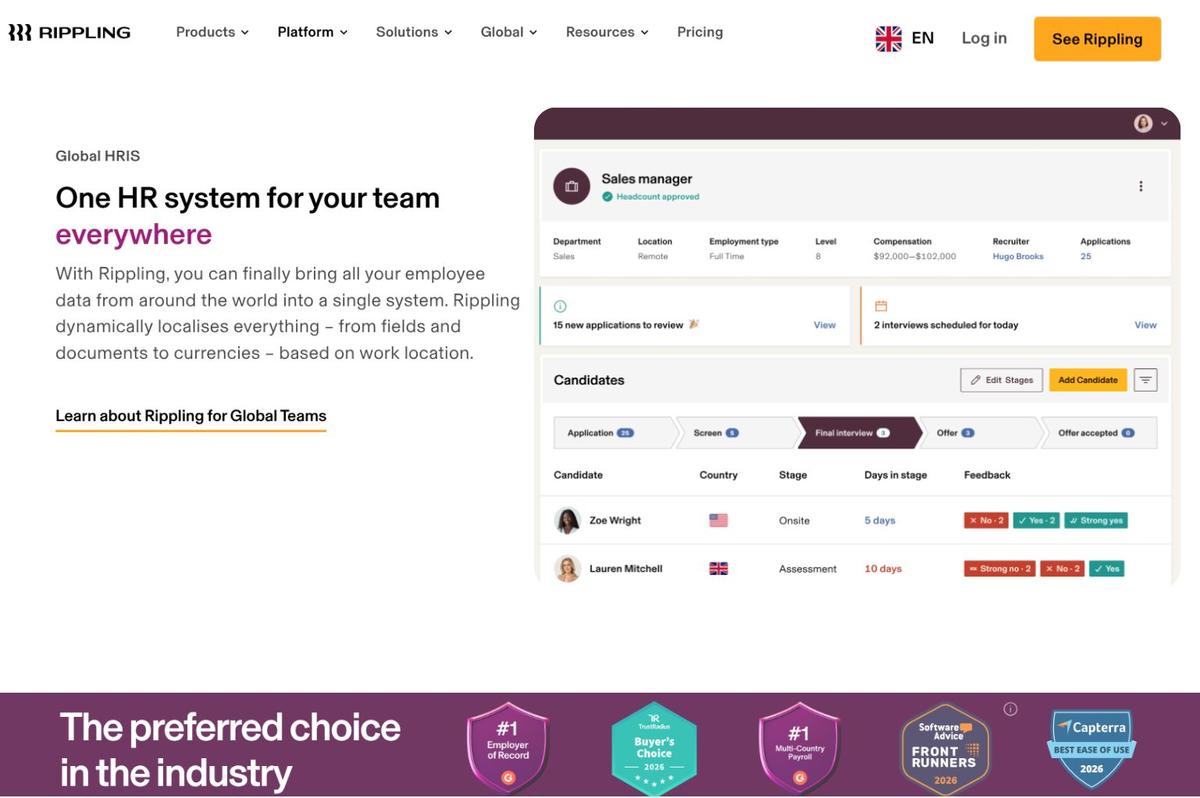
Primary reason for moving from Papaya Global to Rippling: Rippling offers a unique solution that sets it apart in the employee workforce management space. It brings HR, EOR services, and IT support together in one reliable place. This means remote teams can be hired, paid, and mobilized through a single company.
Pros
Rippling effectively breaches the gap between HR, payroll, and IT setup for remote working teams. This is important when you’re looking for one platform that manages all these aspects in one place. It helps you centralize your systems, cuts admin work in half, and strengthens your security frameworks.
Rippling lets you onboard new employees in just a few steps through the HR management features. It automatically handles the basics, including payroll, benefits, contractor services, and global compliance. It also gives employees access to tools like email and Slack. With the IT feature, you can set up laptops and remote devices from wherever you are. This eliminates wasted time while remote employees wait for access to company systems.
Another advantage of Rippling is its powerful automation. Businesses can easily create workflows to automate repetitive tasks across HR, finance, and IT systems. This reduces manual errors and increases compliance as companies expand globally.
Cons
For US-based companies, Rippling is often seen as a leading Papaya Global alternative, but no platform is perfect. The initial setup can take a long time, especially if you’re not used to working with multiple modules (like HR and finance systems, as well as IT) on the same platform. A number of user reviews report this as a challenge. Customization is flexible with Rippling, but it doesn’t go as deep as some enterprise-level EOR tools.
When mid-market companies want to shift from Papaya Global, it's often due to a mismatch in needs, unmet expectations, difficulties with the features, and the platform's complexity. With the sheer number of EOR and employee workforce platforms available on the market, this move can feel overwhelming.
To make this task easier, we’ve shortlisted three of the best Papaya Global alternatives on the market. Rivermate, Remote, and Rippling are all strong contenders for replacing Papaya Global.
Perhaps you’re not ready to take the next step before speaking to an expert? Rivermates global HR experts are ready to answer any questions you might have about your transition from Papaya Global. Speak to an expert now.
The best alternatives to Papaya Global are: Rivermate, Remote, and Rippling. Other alternatives include Velocity Global (now Pebl), Plane, Multiplier, and Skuad (now Payoneer Workforce Management). These service providers all offer a unified platform for payroll, tax, and compliance management, but their approaches differ. They also target different market segments.
The primary Papaya Global competitors are other global hiring and payroll solutions. Currently, this is Rivermate, Remote, Rippling, Deel, and Pebl. These companies compete in the mid-market segment. They provide companies with unified HR and finance systems that facilitate global expansion strategies.
When evaluating Papaya Global alternatives looks for platforms that provide strong support and expertise in the countries you want to hire in. If you are looking into emerging markets, you need to know the platform can handle labor laws, taxes, payroll, and compliance in that country. They should also be legal entities in the countries where they provide EOR services. Examine pricing structures closely. Some platforms offer a modular approach or add-ons, while others charge a flat monthly fee. This matters if you have a tight budget.
A number of platforms are suitable for paying international contractors. Rivermate, Deel, Rippling, Oyster, Remote, RemoFirst, and Papaya Global all have a strong contractor focus and offer multiple payment options. These companies also specialize in contractor hiring and often have local compliance expertise solely focused on contractors. In key markets where onboarding needs to be speedy and efficient, EOR services can prevent companies from making costly compliance errors.

Founder & Managing Director
Lucas Botzen is the founder of Rivermate, a global HR platform specializing in international payroll, compliance, and benefits management for remote companies. He previously co-founded and successfully exited Boloo, scaling it to over €2 million in annual revenue. Lucas is passionate about technology, automation, and remote work, advocating for innovative digital solutions that streamline global employment.
Our Employer of Record (EOR) solution makes it easy to hire, pay, and manage global employees.
Book a demoGlobal Employment Guides
Discover top ADP alternatives for SMEs in 2026. Learn how Rivermate, Payoneer and Remote provide stronger payroll, compliance and global hiring services today.
Lucas Botzen

Industry Insights and Trends
Discover Globalization Partner alternatives updated for 2026. Learn how Rivermate, RemoFirst, Deel, and Papaya Global differ, and the pros and cons of each.
Lucas Botzen

Employee Benefits and Well Being
Learn what fringe benefits are, see common examples, and understand how they’re taxed in the US. A practical guide for employers and HR teams managing benefits.

Martijn Voogt