


Last updated:
September 23, 2026
What is an Employer of Record in Brazil?
An Employer of Record in Brazil is a third-party company that legally hires employees on behalf of foreign employers who have no legal entity in the country. As the legal employer, the EOR handles all compliance.
Foreign employers benefit from the EOR model because it helps companies expand into new markets, removes the administrative burden and provides HR and compliance support in a foreign market.
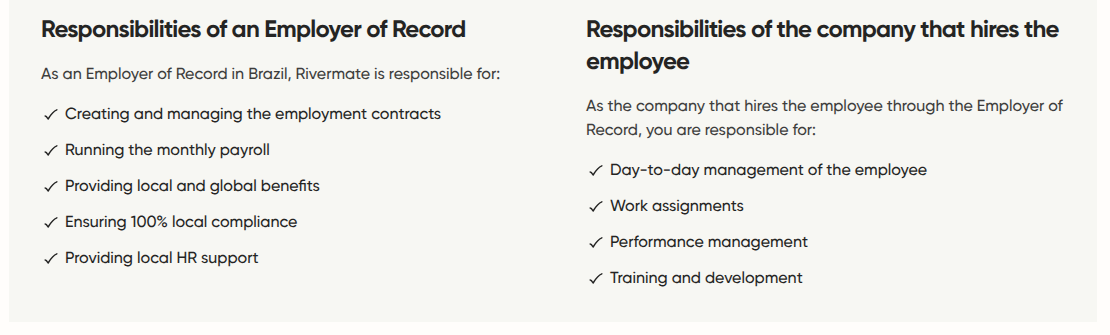
How an Employer of Record, like Rivermate can help with hiring and compliance in Brazil
An Employer of Record (EOR) hires on your behalf through its own local entity, so you can employ in Brazil without registering a company there. Rivermate handles the employment contract, payroll, employer contributions, statutory benefits and filings, and keeps them correct as the rules change.
Brazilian labor market: At a glance
| The hiring market | |
|---|---|
| Greatest hiring activity: | São Paulo, Rio de Janeiro, Minas Gerais |
| Hiring timelines: | Local: Minimum 9 business days Foreign national: 30-60 days |
| In-demand sectors: | Oil and gas, construction, engineering, technology, sales, telecommunications, professional services |
| Sectors with skills shortages: | ICT, manufacturing, engineering, healthcare, logistics and construction |
| The salary market | |
|---|---|
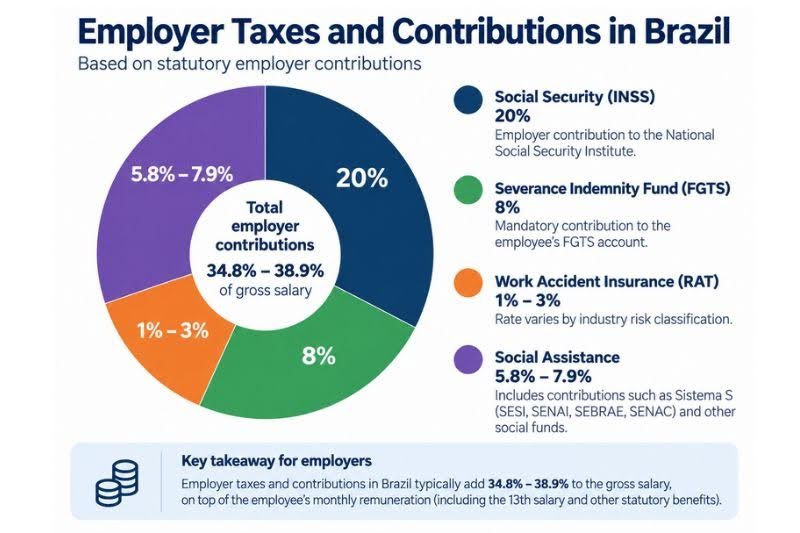
| Employer tax contributions: | Social Security (INSS): 20% Severance Indemnity Fund (FGTS): 8% |
| Work Accident Insurance (RAT): 1%-3% Social Assistance: 5.8%-7.9% | |
| Monthly minimum wage: | BRL 1,621 as of January 2026 |
| Average monthly salary: | BRL 3,560 (equivalent to approx. $692) |
| Income tax rates: | BRL 0 - 2,428.80: Exempt 0% BRL 2,428.81 - BRL 4,664.68+: 7.5% - 27.5% |
What is the true cost of hiring in Brazil?
Local employment laws in Brazil strictly regulate certain rights and employee benefits. These laws may be supplemented by labor union rulings. If an industry collective bargaining agreement exists, consult it for minimum wage levels and mandatory employee rights.
Accurate employment cost calculations include base salary, employer taxes and contributions. Also consider future financial liabilities such as payment of accrued leave and severance pay.
Regional salary differences
Base salaries in Brazil differ by region, industry and job. Here, we look at regional differences and provide a useful benchmark for in-demand sectors.
| Region | Average monthly salary in BRL |
|---|---|
| North-east | 2,475 |
| North | 2,777 |
| Central-west | 4,133 |
| South | 4,026 |
| South-east | 3,958 |
Salaries: In-demand sectors
| Sector | Average gross monthly salary in BRL |
|---|---|
| Oil and gas | 8,000 - 30,000+ |
| Construction | 5,000 - 25,000+ |
| Engineering | 6,000 - 30,000+ |
| Technology | 6,000 - 40,000+ |
| Sales | 5,000 - 30,000+ |
Brazil’s mandatory 13th salary payment
Each year, Brazilian employees receive a mandatory 13th-month salary for a completed year of work. This is known as the décimo terceiro salário or Christmas bonus. The 1st payment is due by 30 November of each year and the second by 20 December. Employees who have not worked a full year receive a pro-rata amount. On termination, you must pay the pro-rata amount to the employee as part of the final settlement.
Employer taxes and contributions
As an employer in Brazil, you must make several contributions toward social security and other benefits.
Employee statutory benefits
Brazilian labor law mandates several employee leave benefits. An employer may offer more than the minimum benefits, but not less. Where a collective bargaining agreement is in place, it sets the minimum leave allowance for an industry.
- Annual leave: 30 days of vacation after one year of work, paid at the regular monthly salary plus one-third.
- Sick leave: Employers generally pay an employee's salary for the first 15 days of a qualifying illness-related absence. From the 16th day, the employee may be eligible for temporary incapacity benefits from the National Institute of Social Security (INSS).
- Maternity leave: 120 days of paid maternity leave. The employee receives their full salary. The INSS reimburses this payment.
- Paternity leave: 5 consecutive days of paid leave. From 2027, new paternity leave entitlements are being introduced as follows:
- 10 days from January 1, 2027
- 15 days from January 1, 2028
- 20 days from January 1, 2029
Union-mandated benefits vs supplementary benefits
In Brazil, several union-mandated benefits exist. These can include additional life insurance contributions and meal vouchers. Employers cannot remove these benefits. However, supplementary benefits such as access to private health insurance or travel allowances are provided at the employer’s discretion.
The bottom line: Fully loaded employment costs under Brazil’s CLT framework frequently reach up to 60% above gross salary. This makes Brazil one of the most expensive employment markets in LATAM.
Employment cost calculator
Use our employee cost calculator to get a more accurate reflection of total employment costs in Brazil.
Calculate Employment Costs
Employment Cost Breakdown
Select a country and enter a salary to see the employment cost breakdown
Practical aspects of hiring in Brazil
| Market condition | Current reality | Notes |
|---|---|---|
| Hiring activity | 🟢 Robust | Increased labour market growth across Brazil. |
| Talent availability | 🟡 Moderate | Some difficulty finding talent, despite a large skilled workforce |
| Specialist talent | 🔴 Competitive | 80% of employers report difficulty finding candidates in technology, engineering and logistics |
| Salary pressure | 🟡 Moderate | Salaries are increasing at a steady rate across sectors |
| Remote work adoption | 🟢 Widespread | A large percentage of workers in major cities work remotely. |
Brazil is a very attractive option for hiring international employees. It has a highly skilled workforce, and many speak Portuguese, English and Spanish. Most of America is only 1-5 hours behind Brazil, and businesses can continue smoothly without major time zone disruptions.
Our local HR expert highlighted several key factors about hiring in Brazil:
- Brazil has strict employment laws that provide strong worker protections. The labor market is primarily governed by the CLT (Consolidação das Leis do Trabalho).
- Authorities require employers to sign and register compliant employment contracts before an employee can start work.
- A medical exam is required before an employee can start working, which increases onboarding time to about 9 days.
- Two-thirds of an employer’s payroll must be local. This limits the number of expats an employer can hire to one-third of the payroll.
- An EOR in Brazil can place people on-site without restrictions, unlike Mexico, where the legal employer needs a special license.
- When hiring in the oil and gas industry, employers need to pay an additional ‘work risk’ cost due to the nature of the work.
- Work permits and visas are tied to the sponsoring employer. If an employee leaves Rivermate without a new sponsorship process underway, Rivermate must notify immigration and cancel the visa.
Compliance spotlight: Brazilian employment contract changes must be approved
In Brazil, the Ministry of Labor and Industry regulates employment conditions through Collective Bargaining Agreements (CBAs). Once basic conditions are set, the relevant authorities must approve changes to an employment contract.
According to our local expert, this kind of review takes some time in Brazil and can delay employee onboarding. Authorities are also unlikely to accept changes that alter mandatory employee rights and benefits. Therefore, these amendments carry a high risk and may not yield the returns employers want.
Hire with confidence, knowing the right support is behind you
With Rivermate’s local HR experts supporting you in Brazil, you can hire confidently, knowing you’re compliant with Brazilian labor laws.
Employer of Record Guide for Brazil
Your step-by-step guide to hiring, compliance, and payroll management in Brazil with EOR solutions.
Compliance risks that employers must know about
Terminations
Terminating an employee in Brazil requires a structured process and involves a notice period and severance calculations. Termination notices must be in writing, dated and signed by both the employer and employee. Notice periods range from 30 to 90 days and depend on the employee’s years of service.
Terminations with cause have the most serious consequences for employees because they are not given a notice period. These terminations usually involve serious misconduct as defined by the Brazilian Labor Code.
When you terminate an employee without cause (for economic or operational reasons), you must pay severance. The employee is paid from the government severance fund (FGTS), but the employer must also pay a 40% penalty on top of the accumulated balance in the fund.
Brazilian law also provides for a mutual agreement termination where both parties agree to end the employment contract. Both the notice period and the severance payment are affected by this type of termination.
Visa options for foreign nationals
The main route for hiring foreign nationals in Brazil is employer-sponsored relocation. A Brazilian employer must apply for authorization to employ a foreign national. Once approved, the candidate can apply for the relevant visa through their local consulate.
Visa options for employer-sponsored foreign workers are:
- VITEM V: Temporary work visa, granted for two years with an extension option.
Candidates must attend an interview with consulate officials and have a clear criminal record check. There are no statutory minimum salary thresholds for these visas; however, it is market practice for highly qualified employees to receive at least a market-related salary.
Overtime for rest days
Brazil has specific laws governing overtime compensation. For example, if an employee works on a rest day or public holiday, overtime must be paid, even if the day off is shifted to another time. Under local labor laws, the alternative day off must be given within the same week, or shortly after the public holiday.
Probation periods
A probation period is not mandatory in Brazil; however, in the current labor market it is a high-risk decision because the law strongly protects workers from dismissal. If you remove the probation clause, employment will be based on an indefinite-term contract from day one and standard termination procedures will apply. A standard probation period in Brazil is 90 days and cannot be extended beyond this limit.
How will hiring through Rivermate Brazil benefit your business?
Navigating Brazil’s complicated employment framework is challenging for most first-time employers. Whether you’ll benefit from hiring through an EOR company, like Rivermate, comes down to two key questions:
- Do you have your own legal entity in Brazil?
- Do you have the skills and resources to navigate through Brazil’s labor laws without making a costly mistake?
If you answered ‘no’ to both, Rivermate could be the simplest way to hire in Brazil. We employ full-time, temporary or contract workers and handle all the compliance. You can focus on your business, confident that your employee is taken care of locally.
Ready to hire in Brazil?
Have you found the perfect candidate in Brazil? Rivermate handles compliant contracts, payroll, benefits and ongoing HR support.
Employ top talent in Brazil through our Employer of Record service
Book a call with our EOR experts to learn more about how we can help you in Brazil







Book a call with our EOR experts to learn more about how we can help you in Brazil.
Trusted by more than 1300 companies around the globe


Frequently asked questions about EOR in Brazil
Sources:
Average earnings of the Brazilian population reach R$ 3,367 in 2025 | News Agency
https://taxsummaries.pwc.com/brazil/individual/taxes-on-personal-income
https://www.planalto.gov.br/ccivil_03/_ato2023-2026/2026/lei/l15371.htm
Written by

Martijn Voogt
Martijn is an Account Executive at Rivermate with several years of experience in the EOR and global HR space. He works with companies expanding internationally, helping them navigate cross-border employment, compliance, and local labor laws without needing to set up entities. His focus is on building scalable sales processes and driving both inbound and outbound growth, collaborating closely with SDRs, Account Managers, and Customer Success teams to support a strong customer journey. He has been actively involved in shaping outbound strategy and go-to-market optimization using tools including Pipedrive, Apollo, and Clay, and regularly advises clients on EOR best practices and global hiring strategies.
View profileReviewed by

Sebastien Wakim
Sébastien Wakim is CEO of Rivermate and has led the Hightekers group since 2024. An early Uber employee, he launched and scaled the company's operations across multiple MENA markets before holding senior leadership roles at OLX Group. He later co-founded Wisewell, a water-technology venture active in the US and GCC. He holds an MBA from Columbia Business School and an MS in engineering from UC Berkeley.
View profile