


Written by

Reviewed by

Last updated:
September 18, 2026
How an Employer of Record works in Spain
In Spain, an Employer of Record hires employees on behalf of international clients without a legal entity in the country. An EOR provider, like Rivermate, becomes the legal employer and manages the entire employment relationship under Spanish labor law. We provide you with:
- The guidance of local experts in Spanish labor law.
- Compliant employment contracts.
- Ongoing management of HR administration and compliance.
- Peace of mind knowing your employees are supported locally.
How an Employer of Record, like Rivermate can help with hiring and compliance in Spain
An Employer of Record (EOR) hires on your behalf through its own local entity, so you can employ in Spain without registering a company there. Rivermate handles the employment contract, payroll, employer contributions, statutory benefits and filings, and keeps them correct as the rules change.
_______________________________________________________________________________________________
Spanish labor market: At a glance
| The hiring market | |
|---|---|
| Greatest hiring activity: | Madrid and Barcelona |
| Hiring timelines: | Local: 1-2 days Foreign national: 20-40 days |
| In-demand sectors: | Artificial intelligence, business intelligence, supply chain management, tech startups, sales, marketing |
| Sectors with skills shortages: | IT, engineering, healthcare |
| The salary market | |
|---|---|
| Employer contributions: | 30% - 40% of annual gross salary |
| Annual gross minimum wage: | €18,931 |
| Average gross annual salary: | €29,500 to €31,600 |
| Income tax brackets: | Between 19% and 45% |
_______________________________________________________________________________________________
Employer costs: The full picture
From an international perspective, hiring in Spain makes sense. It is business-friendly, with deep local and international talent pools. It is also a growing technology, AI and sales hub in the region. But what will the total cost of hiring in Spain be for your company? Answering this question requires looking beyond the base salary to extraordinary payments and employer contributions.
Employee salaries
Salaries in Spain vary by location, industry, job, and the specific skills an employer requires. For example, locals and expats who speak both English and Spanish command higher salaries. In English-speaking cities like Madrid, Barcelona and Valencia, where expat talent pools are large, salaries tend to be significantly higher than elsewhere.
The average annual salary for office-based workers (locals) across Spain is between €30,000 and €38,000, but it can rise significantly when hiring an expat. In-demand positions such as sales managers, country managers, marketing and sales executives, and IT roles earn annual salaries between €30,000 and €60,000+.
According to Spain’s National Statistics Institute (INE), the average gross annual salary in Spain is €29,540, but salaries in major hubs can be much higher. The current figures are:
| Location | Estimated gross annual salary range |
|---|---|
| Madrid | €35,000 - €40,000+ |
| Barcelona | €32,000 - €37,000 |
| Bilbao | €30,000 - €35,000 |
| Valencia | €28,000 - €33,000 |
| Málaga | €25,000 - €32,000 |
In Spain, candidates with both university degrees and 15+ years of industry experience command premium salaries, often 30%-60% above the national average.
13th and 14th month pay
Spain legally mandates a 14th payment salary structure, requiring employers to make a 13th and 14th extraordinary payment (pagas extraordinarias) alongside the standard 12-month salary. Each payment equals one full month of base salary.
Spanish businesses generally use one of two models to calculate these payments. The example below illustrates how each model works.
| Model | Monthly salary | June payment | December payment | Annual total |
|---|---|---|---|---|
| 14 payments | €2,500 | €2,500 | €2,500 | €35,000 |
| 12 payments (pro-rated) | €2,916.67 | Nil | Nil | €35,000 |
The biggest exposure is failing to include the two extraordinary payments in the annual total. This can create a back pay liability and Social Security penalties.
Employer Social Security contributions
The Spanish social security system is very strong and provides workers with excellent benefits. Employers are responsible for making contributions as follows:
| Contribution | Employer Rate | Notes |
|---|---|---|
| Pensions/Healthcare | 23.6% | Covers pensions, maternity leave, and illnesses. |
| Unemployment | 5.5% | Funds unemployment benefits. |
| Salary Guarantee Fund (FOGASA) | 0.2% | Protects employees' pay in case of company insolvency. |
| Vocational Training | 0.6% | Supports professional training programs. |
| Intergenerational Equity Mechanism (MEI) | 0.75% | A newer contribution to support the pension system. |
| Additional Solidarity Contribution | Varies | Applies to earnings exceeding the maximum contribution base. |
Statutory leave benefits
Employees in Spain are entitled to minimum statutory leave benefits. Employers may offer more than these minimums, but never less. The main leave benefits are:
- Annual leave: Employees are entitled to 30 days of paid annual leave.
- Sick leave: Employees can take up to 18 months of sick leave. Payment comes from the social security system and depends on the cause of the illness.
- Parental leave: Each parent is entitled to 16 weeks of paid parental leave.
The bottom line: The total employment costs in Spain are high (similar to those in France, Italy, and Belgium). Social security, severance benefits, and a 14-month salary make up the bulk of these costs.
_______________________________________________________________________________________________
Calculate employment costs
Use our Employment Cost Calculator to estimate total hiring costs in Spain.
Calculate Employment Costs
Employment Cost Breakdown
Select a country and enter a salary to see the employment cost breakdown
_______________________________________________________________________________________________
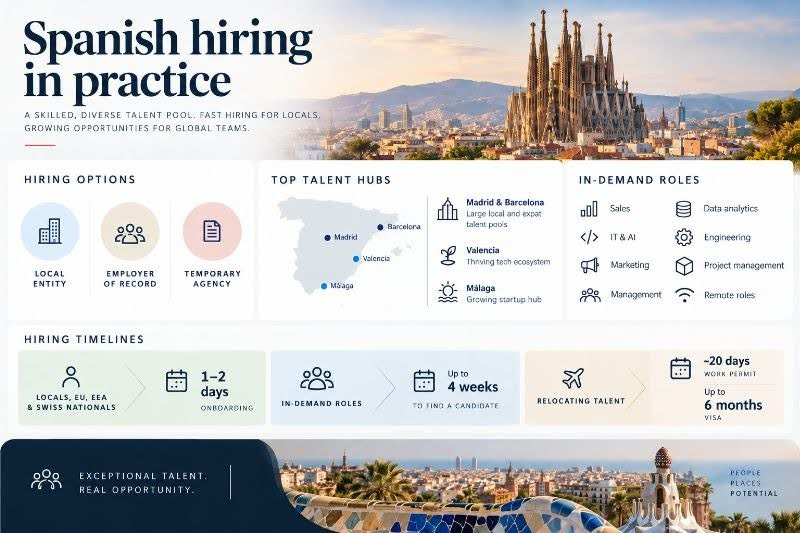
Spanish hiring in practice
Hiring employees in Spain is characterized by excellent talent availability and a quick hiring timeline for locals, EU, EEA and Swiss nationals, plus a fast-growing pool of expat employees.
Hiring options for foreign employers
The first thing to know about hiring in Spain is that you need a local legal entity to hire workers, or you need to use a third-party provider such as an Employer of Record or temporary employment agency.
If you register your own local entity, you will be responsible for handling all compliance according to Spanish labor law. Even with an in-house HR team, they need a strong understanding of employment regulations because Spanish authorities are tough on employee rights.
The depth of the talent pool in major hubs
Spain is a very popular destination for global hiring. In Madrid and Barcelona in particular, large expat talent pools exist. They work mainly as sales professionals, IT experts, AI specialists, marketing agents and directors, managers and data analysts. In major centers where infrastructure projects are ongoing, both local and expat engineers and project managers are in demand. Hiring remote employees is another popular option for global companies, especially in sales and marketing.
Valencia and Málaga are recognized as two emerging startup hubs outside of Madrid and Barcelona. Valencia has a mature, collaborative tech ecosystem backed by foreign investment.
It attracts a disproportionately high number of growth-marketing experts, agile team leaders, UX/UI designers and product professionals.
Hiring timelines
It will not take long to find talent in Spain unless you are looking for highly specialized skills. Office professionals are readily available, and a strong local and expat talent pool is available to recruit from. For in-demand roles such as sales and marketing, AI, business intelligence or supply chain management, it can take up to 4 weeks to find a suitable candidate.
Onboarding locals, EU, EEA or Swiss citizens in Spain is a quick process that takes only 1-2 days once all documentation has been received.
Relocating talent to Spain takes longer because employers must apply for a work permit and the employee must obtain the appropriate visa. Work permits take, on average, 20 days, but visas can take 4-8 weeks to process.
_______________________________________________________________________________________________
Spanish immigration rules: What employers should know
Spain attracts a large number of foreign nationals each year because it offers a high quality of living, an excellent public system and numerous employment opportunities. Relocating your key talent to Spain is straightforward.
Visas have fast turnaround times, usually 4-6 weeks, but the process can take up to 8 weeks, depending on work permit approval, visa type, delays in mandatory checks or local consulate backlogs. Permits are initially for one year and can be extended to four years.
The most common employer-sponsored visa is the Highly Qualified Professional (HQP) visa. The HQP requires a candidate to possess a university degree or at least three years' equivalent of high-level professional experience. For the visa to be approved, the candidate must earn above the minimum threshold of €41,356. This threshold applies to the fixed annual gross salary and cannot include bonuses, performance incentives and commissions.
Advantages of the HQP include faster processing times (usually 20 days), and the employer does not have to prove they could not find local talent to fill the position.
_______________________________________________________________________________________________
How an Employer of Record, like Rivermate can help with work permits in Spain
Navigating work permits can be complex and time‑sensitive. Rivermate coordinates the entire process end‑to‑end: determining the right visa category, preparing employer and employee documentation, liaising with local authorities, and ensuring full compliance with country‑specific rules. Our in‑country experts accelerate timelines, minimize refusals, and keep you updated on each milestone so your hire can start on time—legally and confidently.
_______________________________________________________________________________________________
Compliance obligations that affect hiring in Spain
Spanish employment law is not necessarily difficult to understand, but its application and enforcement can be. From the outset, employers should pay close attention to four elements that can create significant financial liability.
Written employment contract
Spanish labor laws stipulate what information must be included in the written employment contract. For international employers, this can be surprising, especially if your home country doesn't have similar requirements.
Because the written employment agreement forms the basis of the employment relationship, pay close attention to probation periods, notice periods, severance pay, time off, working hours, salary payments, and remote work arrangements, among others. To be validly registered with the Public Employment Service (SEPE), employment contracts must be written in Spanish.
Terminations
Local labor laws provide workers in Spain with strong protections against unfair or procedurally unsound dismissals. Dismissing an employee for poor performance in Spain is especially difficult, and employers face a lengthy process if they take this route.
Notice periods
Employees need to be given at least 15 days' notice when they are going to be terminated for operational reasons. The written notice must include the reasons for termination and the effective date. Employers may pay the employee in lieu of notice instead. A notice period is not required for dismissal due to serious misconduct.
Severance pay
| Type of dismissal | Severance pay |
|---|---|
| Objective dismissal | 20 days of salary for each year of service. Up to a maximum of 12 months' salary. |
| Disciplinary dismissal | No severance pay. |
Regardless of the reason for termination, employees must always receive a final settlement which includes outstanding wages, unused accrued leave and pro-rata extraordinary payments.
Worker misclassification
You can hire independent contractors, known as autónomos, in Spain. But commercial law classifies them as self-employed individuals. They are not viewed as permanent employees.
This means they must have business autonomy to avoid misclassification as employees. That autonomy must extend to working hours, the scope of work, using their own tools and paying their own taxes. To prevent ‘fake freelancers’, the Spanish authorities closely monitor the activities and finances of self-employed individuals.
Employee rights
In Spain, the government provides workers with very strong protections and employee rights. These rights are regulated by the Spanish Workers' Statute (Estatuto de los Trabajadores), Social Security regulations and the Collective Bargaining Agreements (Convenios Colectivos).
The main thing international employers should know is that where these rights exist, the employer cannot offer less than the mandated amounts. This applies to minimum wages, mandatory 13th and 14th payments, working hours, rest periods, paid time off and any other statutory rights the employer must provide.
_______________________________________________________________________________________________
How Rivermate can help employers in Spain
Global employment comes with its own challenges, but they shouldn’t stop you from hiring in Spain. We have the expertise, resources and infrastructure to support your employee or global team in Spain, leaving you free to focus on your business. Our services include:
- Compliant employment contracts written in accordance with Spain’s employment laws.
- Social security registration, managing payroll, tax withholding and benefits administration.
- Ongoing employment administration such as managing paid vacation and other employee rights.
- Adherence to collective agreements that influence minimum wages and employee benefits.
- Employer visa sponsorship for eligible employees and work permit applications.
- Liaison with Spanish tax authorities and immigration offices.
- Dedicated support from global HR experts.
Partnering with us in Spain gives you a cost-effective, simple alternative to going it alone.
_______________________________________________________________________________________________
Ready to hire in Spain?
Rivermate handles the complexities so you can hire with confidence.
Employ top talent in Spain through our Employer of Record service
Book a call with our EOR experts to learn more about how we can help you in Spain







Book a call with our EOR experts to learn more about how we can help you in Spain.
Trusted by more than 1300 companies around the globe


_______________________________________________________________________________________________
Frequently asked questions about EOR in Spain
_______________________________________________________________________________________________
Written by

Lucas Botzen
Lucas Botzen is the Founder of Rivermate, a global employment platform that helps companies hire, employ, and manage talent internationally. Since founding Rivermate in December 2020, he has focused on building practical solutions that simplify international payroll, benefits, taxes, contracts, and employment compliance for remote teams. Before Rivermate, Lucas co-founded and co-directed Boloo, an e-learning and software company that helped entrepreneurs start and grow e-commerce businesses. He scaled Boloo to more than €2 million in annual revenue before successfully exiting the business in 2020. Lucas holds a Bachelor’s degree in Business Innovation from Avans University of Applied Sciences. His background in entrepreneurship, technology, automation, and remote work continues to shape his approach to making global employment simpler and more human.
View profileReviewed by

Sebastien Wakim
Sébastien Wakim is CEO of Rivermate and has led the Hightekers group since 2024. An early Uber employee, he launched and scaled the company's operations across multiple MENA markets before holding senior leadership roles at OLX Group. He later co-founded Wisewell, a water-technology venture active in the US and GCC. He holds an MBA from Columbia Business School and an MS in engineering from UC Berkeley.
View profile